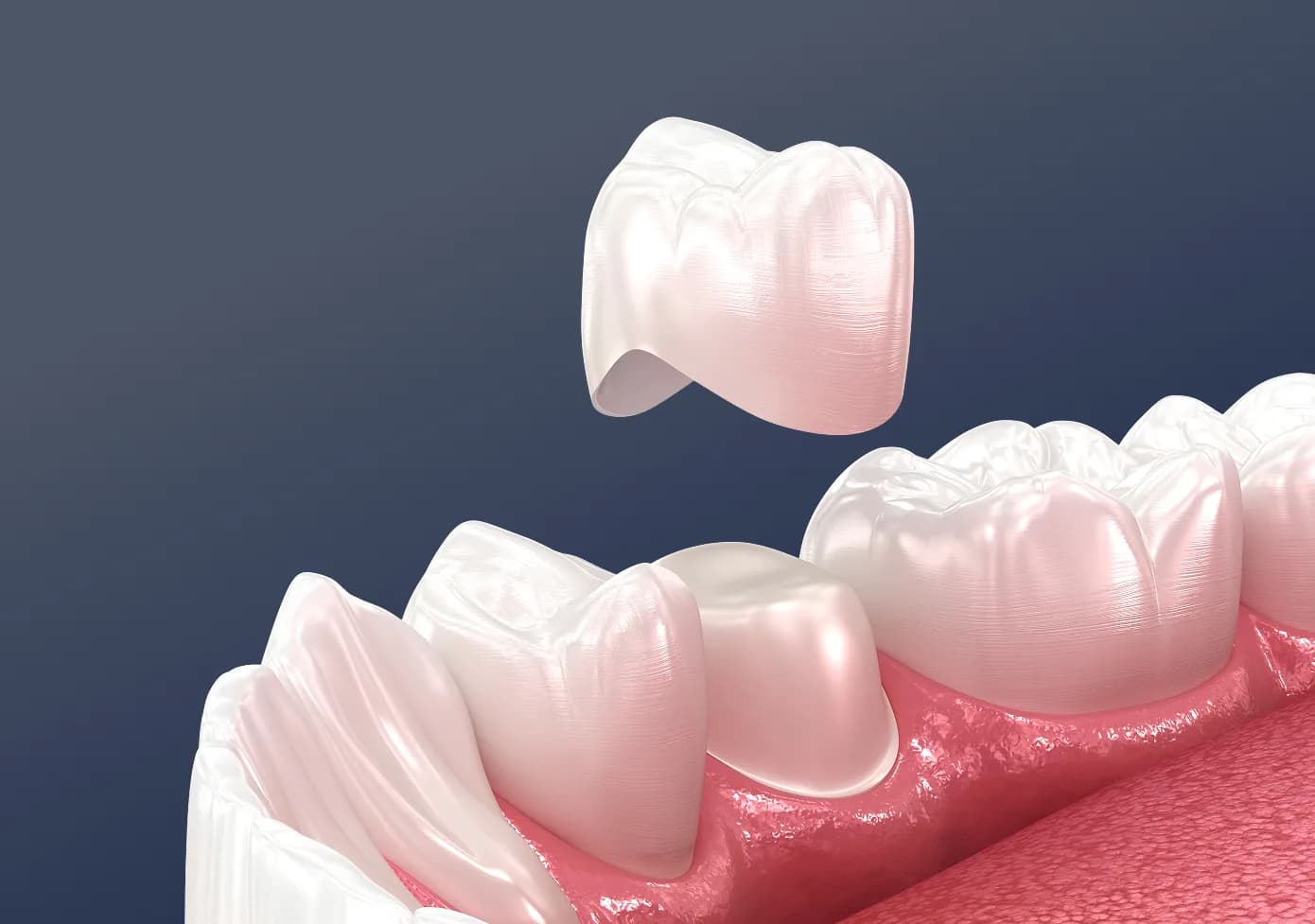
If your dentist has told you that you need a crown, your first questions are probably practical ones. How many visits will it take? Will I need a temporary? Is a crown made in one day as good as one made in a lab?
Both same-day and traditional crowns do the same job: they cover and protect a damaged tooth. The difference is how and where the crown is made. Here's how the two approaches compare, and how to know which is right for your tooth.
What a dental crown does
A crown is a custom cap that covers the entire visible part of a tooth. According to the American Dental Association, crowns are used to:
- Protect a weak tooth from breaking, or restore one that has already broken
- Strengthen a tooth with a large filling when there isn't much natural tooth left
- Cover a tooth that is badly shaped or discolored
- Cover a dental implant or hold a bridge in place
Think of a crown as a helmet for your tooth. A helmet doesn't repair your head; it takes the force of an impact so your head doesn't have to. A crown works the same way. When a tooth has been weakened by a large filling, a crack, or a root canal, everyday chewing can be enough to break it. The crown covers the tooth and takes that biting force, protecting what's underneath. And just as wearing a helmet doesn't mean you stop being careful, the tooth under a crown still needs brushing, flossing, and checkups.
A crown is also commonly recommended for a back tooth after a root canal, since those teeth can become more brittle over time.
How a traditional crown is made
A traditional crown usually takes two appointments, roughly two weeks apart:
- First visit: The dentist numbs the tooth, shapes it, and takes an impression, either with a putty-like material or a digital scan. A temporary crown is placed to protect the tooth.
- In between: The impression goes to an outside dental laboratory, where a technician makes the final crown.
- Second visit: The temporary is removed, the tooth is usually numbed again, and the permanent crown is fitted and cemented.
This approach has served patients well for decades, and it is still the best choice in some situations.
How a same-day CEREC crown is made
CEREC is a digital system that lets the dentist design and make a ceramic crown in the office. At Atlas Dental, the process looks like this:
- Preparing and protecting the tooth. After numbing, the tooth is shaped to make room for the crown and sealed with a thin protective coating.
- Digital scan. A small camera wand takes a 3D scan of your tooth and bite. There's no putty impression.
- Design. The crown is designed on screen to fit your tooth, your bite, and the teeth beside it.
- Milling. An in-office milling unit carves the crown from a solid block of e.max, a strong, tooth-colored ceramic.
- Finishing and bonding. The crown is polished or glazed, checked for fit and bite, and bonded to your tooth.
You leave with your permanent crown the same day. Plan for one longer visit of about 90 to 120 minutes, including time while the crown is being milled. See every step of a same-day dental crown visit.
Same-day vs. traditional crowns at a glance
- Number of visits: Same-day CEREC crowns usually take one. Traditional lab crowns usually take two.
- Temporary crown: Usually not needed for a same-day crown. With a traditional crown, you wear one for about two weeks.
- Impressions: A digital scan for same-day crowns. A putty impression or digital scan for traditional crowns.
- Numbing: Once for a same-day crown. Usually twice for a traditional crown.
- Where it's made: Same-day crowns are made in our office. Traditional crowns are made in an outside dental laboratory.
- Material: Same-day crowns are e.max (lithium disilicate) ceramic. Lab crowns come in a wide range of materials, including zirconia and layered porcelain.
Are same-day crowns as strong and long-lasting?
At Atlas Dental, same-day crowns are milled from e.max, a lithium disilicate ceramic made for chewing forces. Research on lithium disilicate crowns has found survival over the first several years comparable to traditional porcelain-fused-to-metal crowns. As with any crown, how long it lasts depends on the tooth underneath, your bite, whether you grind or clench, and how well you care for it.
Because the crown is milled from a single solid block, there's no layered porcelain to chip, and skipping the temporary removes the risk of a temporary coming loose or breaking between visits.
When a traditional crown may be the better choice
Same-day crowns are an excellent fit for most teeth, but not all of them. At Atlas Dental, we place a temporary and have a lab make the final crown when:
- There isn't enough room for e.max. An e.max crown needs a certain thickness to be strong. When the space is too tight, a zirconia crown is the stronger choice.
- A front tooth needs custom esthetics. Some front teeth need highly customized color and layering to match their neighbors.
- We're concerned about the tooth's nerve. If a tooth may need a root canal, a temporary lets us see how the nerve settles before committing to the final crown.
- A bridge is needed to replace one or more missing teeth.
If any of these applies, we'll explain why before we start.
Same-day crowns at Atlas Dental
At Atlas Dental in New Boston, NH, same-day crowns are placed by Dr. Daniel Mejia, who earned his Doctor of Dental Medicine degree from Tufts University School of Dental Medicine and has been using CEREC for nearly a decade.
Most of our same-day crowns are very conservative. We keep as much of your natural tooth as possible, because bonding to enamel is stronger than bonding to the inner layers of the tooth, and preserving tooth structure is a core principle of modern dentistry. If an onlay would protect your tooth while saving even more of it, or if a lab crown is the better fit, Dr. Mejia will tell you.
Intraoral cameras let you see exactly what we see before any recommendation, and laughing gas is available in every treatment room if you'd like help relaxing. We care for patients from New Boston, Goffstown, Weare, Mont Vernon, Francestown, and nearby towns.
Frequently asked questions
Do same-day crowns look natural?
Yes. Our same-day crowns are made of e.max, a tooth-colored ceramic, and are shaded to blend with your natural teeth. For a front tooth that needs very detailed color matching, we may recommend a lab crown instead.
How long does a same-day crown last?
With good care, a crown can last many years. Its lifespan depends on the material, the health of the tooth underneath, your bite and grinding habits, and regular checkups, whether it was made in the office or in a lab.
Does insurance cover same-day crowns?
Dental plans usually treat a same-day crown like any other crown, but coverage varies by plan. Our team can help you understand your benefits before treatment. See our insurance information.
Can every tooth get a same-day crown?
Most can. A lab-made crown may be better when there isn't enough room for e.max, when a front tooth needs custom esthetics, or when we want to watch the tooth's nerve before finishing. We'll check during your exam.
Is a same-day crown more expensive?
No. At Atlas Dental, we don't charge extra for a same-day crown. You get the convenience of one visit at no additional cost.
Find out if a same-day crown is right for you
If you've been told you need a crown, or you have a cracked or heavily filled tooth, we'd be glad to take a look and talk through your options. Learn more about our same-day CEREC crowns, call Atlas Dental at (603) 487-2106, or book an appointment online.